Defense Counsel Journal
A Defense Attorney's Guide to the Galaxy - Space Debris Claims in the United States
Volume 92, No. 3
November 24, 2025
 Mica Nguyen Worthy
Mica Nguyen Worthy
Mica Nguyen Worthy is a partner in the Charlotte office of Cranfill Sumner and chairs both the firm’s Aviation & Aerospace Practice Group and International Business Law Group. She represents a wide range of clients across the aviation and global supply chain industries, including aircraft owners, operators, manufacturers, and service providers in matters involving business disputes, contracts, products liability, and aviation accidents. A Certified Global Business Professional (NASBITE), she advises international clients (particularly in aviation and construction) on contract negotiations, arbitration, and cross-border commercial disputes. Mica is a founding Board Member and current Chair of the Charlotte International Arbitration Society and has also chaired the N.C. Bar Association’s International Law & Practice Section. She is an active member of the IADC’s Transportation/Aviation, International Arbitration, and International Law Committees.
I. Space Debris and the Otero Matter
A. Overview of Space Debris and its Impact
NASA scientist Donald J. Kessler first identified a catastrophic space debris scenario where the density of space “junk” in low Earth orbit (“LEO”) becomes so numerous that it could cause a cascade in which each collision generates space debris that increases the likelihood of further collisions.1Donald J. Kessler and Burton G. Cour-Palais, “Collision Frequency of Artificial Satellites: The Creation of a Debris Belt” 83 J. Geophys. Res. 2637 (1978).
He theorized that space debris was getting to the point where LEO was so polluted it would cause damage to all new and existing satellites.2Donald J. Kessler, “Collisional Cascading: The Limits of Population Growth in Low Earth Orbit,” 11 Advances in Space Research 63 (1991).
The space community has increasingly grown concerned that the space debris issue may result “trapping” ourselves on Earth due to the inability to safely exit Earth’s atmosphere.3Joel R. Primack, “Debris and Future Space Activities,” Presentation at Conference on Future Security in Space, University of Southampton Mountbatten Centre, May 28-29, 2002 (PDF), available at https://web.archive.org/web/20250831185402/http://physics.ucsc.edu/cosmo/Mountbat.PDF. With enough orbiting debris, pieces will begin to hit other pieces, setting off a chain reaction of destruction that will leave a lethal halo around the Earth.
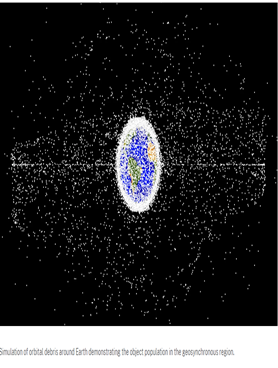
Photo Credit: NASA
This “Kessler effect” becomes ever more likely as satellites and space objects in LEO increase. As of this article’s publication, an estimated 600,000 pieces of “space junk” exist, and on average, collision with other satellites or space junk destroys one satellite per year.4“Lockheed Martin in space junk deal with Australian firm,” BBC News (August 28, 2014), available at https:/www.bbc.com/news/business-28948367.
With the increase of SpaceX’s Starlink program and space enterprises more globally in recent years, the international space community remains very concerned about the potential Kessler effect. SpaceX’s position is that Starlink satellites have achieved lower latency, are expected to deorbit within five years due to atmospheric drag, and they are expected to burn up in the atmosphere.5Jeff Foust, “Starlink failures highlight space sustainability concerns,” SpaceNews (July 2, 2019), available at https://spacenews.com/starlink-failures-highlight-space-sustainability-concerns/.
Other commercial space operators do not even purport to have similar expectations for their satellite programs.
The U.S. Air Force operates a Space Surveillance Network, which tracks objects in space with radar and optical sensors at various sites and maintains the most complete catalog of objects on orbit. Sensors observe and track objects that are larger than a softball in LEO, and basketball-sized objects or larger in higher orbits.6The Aerospace Corporation, “Space Debris 101”, available at https://aerospace.org/article/space-debris-101.
If the U.S. Air Force predicts a collision between a catalogued object and a known operational satellite, they usually attempt to notify the owner/operator.
Many other organizations and individuals are dedicated to the study of and proposed mitigation or elimination of space debris. The Aerospace Corporation, an independent, nonprofit, but U.S.-funded think-tank, created the Center for Orbital and Reentry Debris Studies (“CORDS”), which keeps a database of all reentry of space debris, working closely with NASA.7The Aerospace Corporation, CORDS Reentry Database, available at https://aerospace.org/reentries.
Based on its tracking and data, the Aerospace Corporation estimates the overall risk of injury to individuals from returning debris is less than one in one trillion.8Space Debris 101, supra note 6.
In 2023, as a result of my toddler’s fascination with outer space and my own interest in the firm’s Aviation and Aerospace work, we researched space liability issues and wrote an article on the Kessler Effect as it relates to space insurance policies, “Your Chance of Getting Hit by Space Junk Is Extremely Low, but it’s not Zero!”9Mica Nguyen Worthy, “Your Chance of Getting Hit by Space Junk Is Extremely Low, but it’s not zero,” Cranfill Sumner (Sept. 20, 2023), available at https://www.cshlaw.com/resources/the-current-universe-of-space-insurance/.
In March 2024, Alejandro Otero’s home in Florida was hit by space debris that caused significant damage to property and nearly hit his son, Daniel Otero, who was home at the time of the impact. Mr. Otero reached out to me because of my space debris article, and after speaking with him, we realized this was a unique situation with complex legal issues.
On May 22, 2024, we submitted claims to NASA on behalf of the Oteros, arguing that NASA should be held to a “strict liability” standard consistent with the United States’s commitment to international law, but alternatively, we articulated a claim on a negligence basis under the Federal Torts Claim Act emphasizing res ipsa loquitur on the evidence of negligence.
On November 22, 2024, NASA offered to settle, and the Oteros accepted. The parties executed releases were without confidentiality requirements, and NASA paid a total of $44,151.22 to the Oteros and its homeowners’ insurance carrier. In 2025, the Oteros received payment for the first ever space debris claim in United States history.
B. Facts of the Otero matter
On or about March 11, 2021, the International Space Station (“ISS”) released a cargo pallet of depleted, discarded batteries (called Exposed Pallet 9 or “EP9”) in an uncontrolled reentry back to Earth.10National Aeronautics and Space Administration (hereinafter, “NASA”), “Iss064e041512,” NASA Image and Video Library (March 11, 2021), available at https://images.nasa.gov/search?q=%20iss064e041512%20&page=1&media=image,video,audio&yearStart=1920&yearEnd=2025.
“Uncontrolled reentry” means that there was no directed, manned, or specific operation to facilitate the reentry. EP9 was essentially dumped off the ISS allowing atmospheric drag to eventually pull it into the Earth’s gravitational force to bring EP9 back down to Earth at an uncontrolled date and time.
NASA and its counterparts with the ISS made the decision to release EP9, with mission controllers in Houston TX commanding the release.11NASA, “An external pallet is released from the Canadarm2 robotic arm,” (March 18, 2021), available at https://www.nasa.gov/image-article/an-external-pallet-released-from-canadarm2-robotic-arm-3/.
At the time, NASA reported that the debris would “harmlessly” burn up in the Earth’s atmosphere,12Iss064e041512, supra note 10.
despite the fact that it was one of the most massive objects ever released from the ISS at 2.6 metric tons.
Two years after the ISS’ release, EP9 finally reentered Earth’s atmosphere on Friday, March 8, 2023. A piece of EP9 broke off, survived reentry, and fell through the roof of the Oteros’ home in Naples, Florida. Alejandro and Cindy Otero were the property owners, while their son Daniel Otero was present and in the next room where the object landed.
CORDS recorded the predicted reentry time shown below, where the possible reentry locations were anywhere along the blue and yellow ground tracks:13CORDS Reentry Database, supra note 7, at ISS DEB (ICS-EF) (ID 45265).
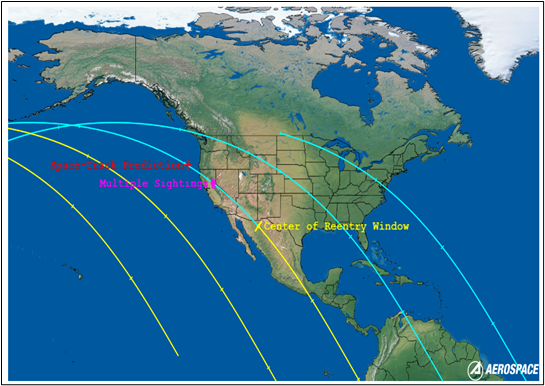
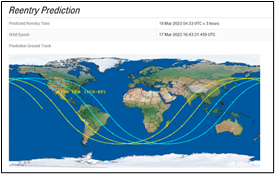
Graphics courtesy of Aerospace Corporation
U.S. Space Command recorded the reentry of the space debris at 2:29 pm EST,14Stephen Clark, “A hunk of junk from the International Space Station hurtles back to Earth,” Ars Technica (March 8, 2024), available at https://arstechnica.com/ space/2024/03/a-hunk-of-junk-from-the-international-space-station-hurtles-back-to-earth/.
and the Oteros’ home security videos recorded the sound of the crash from the impact at 2:34 pm EST. According to U.S. Space Command, the expected path of the space debris was heading over the Gulf of Mexico, towards southwest Florida. All the evidence appeared consistent with the foreign object being space debris.
Daniel was “stunned” and “shaken” by the event. When he went to look for the cause of the loud crash, he saw the hole in the roof and realized something had fallen in and all the way through the second floor of the house to the subflooring where the item finally landed. In news reports, Daniel described he was in a “state of shock.”15Annalise Iraola, “Object from the sky crashes through Naples family’s ceiling and floor,” WINK News, (March 15, 2024), available at https://www.winknews.com/ news/collier/object-from-the-sky-crashes-through-naples-family-s-ceiling-and-floor/article_810f101f-5cdd-57a5-b499-4b7dafbc476a.html.
Fortunately, no one was physically injured.
The Oteros called the police and reported the incident to the sheriff’s office to investigate. On March 12, 2024, the officer retrieved an object from the subflooring that the officer described as partially melted.16Bryant Pursley, Sheriff’s Office Collier County Incident Report, (March 8, 2024) (available on file with author).
The Oteros suspected it was from outer space and were concerned that the object might contain dangerous materials, so they also called the fire department to request testing. No one was able to definitively determine what the item was or confirm that it was not hazardous, so the Oteros only handled it with gloves and tongs to avoid harmful exposure or contamination and placed it in a box.
This photograph of the space debris taken by Alejandro was circulated in the news:
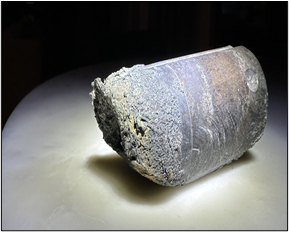
Photo courtesy of the Oteros
Alejandro also called his homeowner’s insurance and made a claim for the property damage. The insurer adjusted the claim and paid for the property repairs, less Alejandro’s deductible. Alejandro was the lead contact for all the contractors (rather than the insurance carrier) and organized the repair efforts, interrupting his work and taking him away from his business.
Alejandro also spent a significant amount of time trying to determine who to contact about the incident. He reached out to NASA and left messages and sent emails without a response. He reached out to research students and prominent persons in the space community on X and other social media, seeking the appropriate contacts. He did not receive immediate contact from NASA or others in the space community at that time.
In the end, Alejandro went to his local news media “in a panic” trying to get answers.17Iraola, supra note 15.
WINK News had an aviation expert confirm that the space debris was not aviation-related (aircraft related), and reporters reached out to NASA when it broadcasted the news event.
After this news report, NASA reached out to Alejandro seeking to retrieve the item for its analysis. The Oteros engaged legal counsel to assist with the process. Our firm made contact with NASA to arrange for the transfer of the space debris for NASA’s analysis, and to have an independent evaluation by our materials experts at Engineering Systems, Inc. (“ESi”). ESi assisted with a non-destructive inspection and documentation of the space debris prior to the exchange (see select photos below). ESi then also documented the exchange with NASA on March 28, 2024.
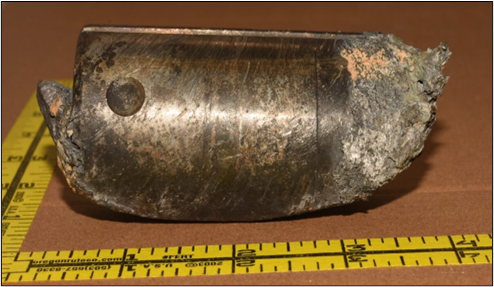
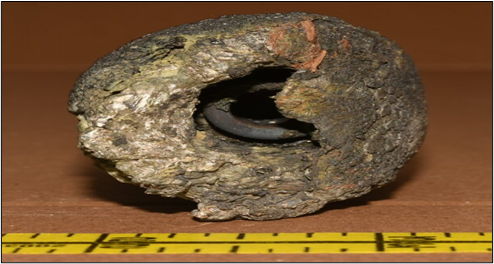
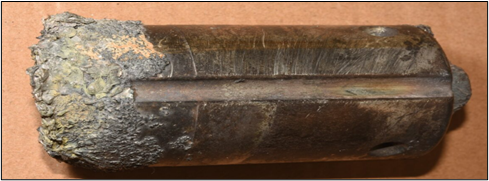
Photos courtesy of ESi.
We also requested “reasonable assurance” from NASA that the item was not hazardous to the Otero family based on its initial investigation of the reentry of the space debris. NASA provided reasonable assurance that there were no known risks, but that handling the item with personal protective equipment was appropriate.
On April 15, 2024, NASA completed its analysis18Mark A. Garcia, “NASA Completes Analysis of Recovered Space Object,” NASA, (April 15, 2024), available at https://www.nasa.gov/blogs/spacestation/2024/04/15/nasa-completes-analysis-of-recovered-space-object/.
and determined the space debris was a stanchion from the NASA flight support equipment used to mount the batteries on the cargo pallet, EP9. The object was made of Inconel, a metal alloy. It weighed 1.6 pounds, was 4 inches in height, and 1.6 inches in diameter.19Id.
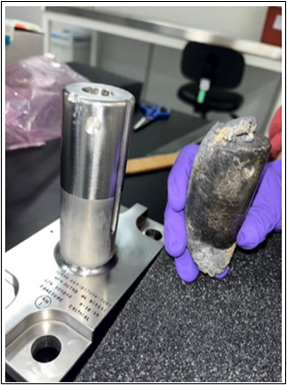
Photo courtesy of NASA
C. Insurance Component of the Claim
Generally, falling objects causing property damage to homes are covered under standard homeowners and business property insurance policies. As a first-party claim, such policies would cover the damage that the falling object caused to the structure of the home or business, as well as to property or belongings that are also damaged or destroyed as a result.20See infra, Section 3.
For the Oteros’ homeowners’ insurance, there were no policy exclusions for satellites, asteroids, meteors, or space debris as a falling object. Thus, the claim was adjusted and paid in the ordinary course, and the carrier sought to subrogate the damages. The carrier’s attorneys reached out to me to work together on making the claims against NASA for both the insured and the non-insured damages with the appropriate proofs of loss.
As a practical matter, falling space debris is likely to be treated like any other falling object. So, if space debris were to fall on a car, coverage might also be provided under the comprehensive portion of an auto insurance policy. Likewise, if falling space debris causes an auto accident or damages to others, the liability portion of the policy would also likely cover medical expenses or related lawsuits for personal injury. Had the space debris falling on the Otero’s home also caused personal injury, the liability portion of their homeowners’ insurance policy likely would have applied.
If there had been personal injury in the Oteros’ any medical expenses primarily would have been covered under their health insurance. If there had been a fatality, life insurance policies would have been triggered in the ordinary course.21Id.
Space liability insurance is also available to those involved in space operations.22Mica Nguyen Worthy, “The Current “Universe” Of Space Insurance,” Mondaq (Sept. 21, 2023), available at https://www.mondaq.com/unitedstates/insurance-laws-and-products/1368560/the-current-universe-of-space-insurance.
These policies are “all risk” and cover first-party as well as third-party claims. From our research and discussions with aerospace insurance carriers, the current focus of risks involves collision with space debris during launch or orbit. Many insurance carriers are working with their customers and technical experts in the field to track, mitigate, and assess such risks.23Christopher T.W. Kunstadter, What Keeps Space Insurers Up at Night, 34 Air & Space Lawyer 10 (2022), available at https://www.iuai.org/common/Uploaded%20files/Bulletins%202022/ASL_v034n03_Kunstadter.pdf.
There are even projects currently underway to seek and remove space debris in LEO.24Jeff Foust, “Astroscale finalizes contract for Japanese debris removal mission,” SpaceNews (Aug. 21, 2024).
Indeed, U.S. regulators have also started to require orbital space debris mitigation policies among the requirements for space operations in addition to insurance coverage requirements.
Insurance companies are in the business of risk analysis, transfer, and mitigation. They play an important role in the advancement of space operations. However, space policies are not focused on the potential injury or damage to third parties on the surface of the Earth as much as with the potential for collision in orbit. Domestic property and casualty insurance carriers are more likely to deal with and handle the process of adjusting claims like the Oteros’.
II. Space Law in the U.S. Related to Space Debris
Space law and United States policy are not clear as to how one may make a “space debris claim” against the U.S. The U.S. has ratified the United Nation Convention on Convention on International Liability for Damage Caused by Space Objects in 1967 (the “Space Liability Convention”), which under the Supremacy Clause makes it the “law of the land.” The Space Liability Convention applies between countries but does not create a private right of action for individuals. Thus, the Oteros would have to make a domestic claim against the United States government under U.S. law.
The United States is committed to the responsible and constructive use of space, promoting a robust commercial space industry, and defending the U.S. and allied interests in space, among other goals.25National Space Policy of the United States of America, (Dec. 9, 2020), available at https://trumpwhitehouse.archives.gov/wp-content/uploads/2020/12/National-Space-Policy.pdf.
As a consequence the government has committed to special attention and measures to mitigate orbital debris to preserve the environment.26Id. at 5, 14
The U.S. has a responsibility to limit the creation of new debris and mitigate the risks from orbital debris.27Id.
A. The Commercial Space Launch Competitiveness Act of 2015 and Space Debris Claims
Congress passed the Commercial Space Launch Competitiveness Act of 2015 (“CSLCA”) to “spur” commercial spaceflight and innovation by temporarily postponing significant regulatory oversight of private spaceflight companies; extending the period during which the government indemnifies commercial spaceflight companies for third-party damages beyond the company’s required liability insurance; and granting private companies the right to own resources collected in space, such as materials from asteroid mining.28Commercial Space Launch Competitiveness Act of 2015, Pub. L. 114-90 (2015).
Under CSLCA, private companies in the United States may now extract and sell the resources obtained from outer space missions and celestial bodies. Several other governments have followed suit. In light of these efforts, the U.S. has moved forward with the Artemis program to return mankind to the moon29See NASA, “Artemis”, available at https://www.nasa.gov/feature/artemis/.
and has partnered with SpaceX and other private commercial companies to develop its space operations.30Roxana Bardan, “Seven US Companies Collaborate with NASA to Advance Space Capabilities,” NASA (June 15, 2023), available at https://www.nasa.gov/news-release/seven-us-companies-collaborate-with-nasa-to-advance-space-capabilities/; NASA, “NASA, SpaceX Sign Joint Spaceflight Safety Agreement,” NASA (Mar. 18, 2021), available at https://www.nasa.gov/news-release/nasa-spacex-sign-joint-spaceflight-safety-agreement/.
For a private operator in the United States to obtain a launch or reentry license, the licensee must either obtain liability insurance or demonstrate an independent financial ability to compensate for “maximum probable loss from claims” by – (a) a third party for death, bodily injury, or property damage or loss resulting from an activity carrier out under the license; and (b) the U.S. Government against a person for damage or loss to Government property resulting from an activity carried out under the license.3151 U.S.C. § 50914(a).
The initial liability insurance coverage to a launch or reentry licensee for third-party death, bodily injury, or property damage is capped at $500 million.32Id. at § (a)(3)
The United States government indemnifies commercial spaceflight companies for third-party damages beyond the company’s required liability insurance up to greater than $3 billion (after which exposure then reverts back to the commercial entity).33Congressional Research Service, Commercial Space: Federal Regulation, Oversight, and Utilization, R45416 (Nov. 29, 2018) (insurance requirements), citing 51 U.S.C. §50915. The statute sets the maximum indemnification amount at $1.5 billion, adjusted for inflation since 1989. The Government Accountability Office (see footnote 19) estimates that this amount is $3.1 billion in 2017 dollars.
Few other nations actually require space liability insurance, partially due to the fact that so much space activity is unregulated.34Jeanne Suchodolski, An Overview and Comparison of Aviation and Space Insurance, 14 J. Bus. & Tech. L. 469, 474 (2019), available at https://digitalcommons.law.umaryland.edu/cgi/viewcontent.cgi?article=1303&context=jbtl.
NASA was established in 1958,35Pursuant to the Space Act of 1958, P.L. 85-568 (1958).
and in 2017, NASA’s authorization was re-focused on long-term deep space human exploration; investments in science, technology and aeronautics portfolios; and growing the commercial space sector. Later, the National Aeronautics and Space Administration Transition Authorization Act of 2017 specifically noted Congress’ findings that orbital debris poses serious risks to the operational space capabilities of the U.S.36P.L. 115-10 (2017) at Sec. 839(a)(1).
The Act required a report on the status of international coordination and development of orbital debris mitigation strategies and removal concepts.37Id. at Sec. 840(b).
NASA has further established its own Orbital Debris policies, which include policies on modeling, measurement, protection, mitigation, remediation, and reentry.38NASA, “Debris Reentry,” available at https://orbitaldebris.jsc.nasa.gov/reentry/.
NASA explains on its website that:
Due to the increasing number of objects in space, NASA and the international aerospace community have adopted guidelines and assessment procedures to reduce the number of non-operational spacecraft and spent rocket upper stages orbiting the Earth. One method of post-mission disposal is to allow the reentry of these spacecraft, either from natural orbital decay (uncontrolled) or controlled entry.39Id.
There are two NASA methods to compute the reentry survivability of spacecraft components:
- Debris Assessment Software: A conservative, easy-to-use tool
- Object Reentry Survival Analysis Tool: A more accurate, higher-fidelity model requiring operator expertise and training
Regarding modeling, NASA explains:
NASA scientists continue to develop and upgrade Orbital Debris models to describe and characterize the current and future debris environment. Engineering models, such as ORDEM 3.2, can be used for debris impact risk assessments for spacecraft and satellites, including the International Space Station, whereas, evolutionary models, such as LEGEND, are designed to predict the future debris environment. They are reliable tools to study how the future debris environment reacts to various mitigation practices.40NASA, “Debris Modeling,” available at https://orbitaldebris.jsc.nasa.gov/modeling/#:~:text=NASA%20scientists%20continue%20to%20develop,reacts%20to%20various%20mitigation%20practices.
These orbital debris models are part of the Orbital Debris Mitigation Standards Policy (“ODMSP”) generated by NASA. In addition to ODMSP, the Federal Aviation Administration has also provided its “Report to Congress on the Risk Associated with Reentry Disposal of Satellites from Proposed Large Constellation in LEO.”41Federal Aviation Administration, Report to Congress Reentry Disposal of Satellites from Proposed Large Constellations in Low Earth Orbit, Aerospace OTA Work Plan 2021-1 (Sept. 22, 2023), available at https://www.faa.gov/sites/faa.gov/files/Report_to_Congress_Reentry_Disposal_of_Satellites.pdf.
The FAA’s conclusions were consistent with NASA’s findings that:
It is clear from this analysis that uncontrolled deorbit and reentry of constellations of satellites and launch stages may pose higher than desired risk to both people on the ground and in aircraft. Constellation operators should be encouraged to use the ODMSP’s preferred disposal option, direct targeted reentry, for disposing of constellation-related hardware.42Id. at 35.
United States regulations and policy are focused on collisions in orbit and the impact of space debris on space flight operations. There is little (if anything) written that addresses the impacts to U.S. persons and property on the surface of the Earth as a result of U.S. space operations. In any event, one would expect NASA and the FAA to place a safety preference for “controlled” reentry or “direct targeted reentry” of space debris as compared to the less desirable “uncontrolled” reentry of objects back into Earth’s atmosphere.
B. U.S. Focus on National Security Implications of Space Debris
Space law experts following space debris issues often attribute the origin and the initial high volume of space debris to direct-ascent anti-satellite missile tests (“ASMTs” or “DA-ASATs” or “ASATs”). One of the first ASMTs in the 1980s occurred when the United States struck the Solwind P78-1 satellite with a 14-kg payload, which created significant amounts of space debris that were anticipated to remain in orbit well into the 1990s.43David S.F. Portree and Joseph P. Loftus Jr. “Orbital Debris: A Chronology,” NASA TP-1999-208856 (1999), available at https://ntrs.nasa.gov/api/citations/19990041784/downloads/19990041784.pdf.
Since then, China, Russia, India, and other spacefaring nations have also conducted ASMTs, creating more and more space debris. In 2023, the Biden Administration specifically stopped the practice of ASMTs specifically because of the growing space debris concern.44The White House, Fact Sheet, “Vice President Harris Advances National Security Norms in Space”, (April 18, 2022), available at https://www.presidency.ucsb.edu/documents/fact-sheet-vice-president-harris-advances-national-security-norms-space.
The two largest orbital debris-generating events known to date were the 2007 Chinese ASAT and the 2009 collision of the Iridium 33 and Cosmos 2251 satellites (U.S. and Russian satellites, respectively). The Chinese ASAT intentionally destroyed a derelict Chinese meteorological satellite causing over 3,300 new tracked fragments. The Iridium-Cosmos collision was not intentional, but it created over 2,200 new tracked fragments. In 2021, a Russian ASAT intentionally destroyed a derelict Russian satellite and created over 1,100 new tracked fragments and caused the crew of the ISS to have to take evasive maneuvers to avoid the cloud of debris.45Kunstadter, supra note 23.
In 2022, Russia’s ASAT test was the first intercept with Russia’s modern system and created an enormous amount of space debris that put the ISS (including their own cosmonauts) in danger.46Chelsea Gohd, “Russian anti-satellite missile test was the first of its kind,” Space (Aug. 10, 2022), available at https://www.space.com/russia-anti-satellite-missile-test-first-of-its-kind.
In 2024 alone, the ISS had to adjust its orbit and maneuver many times to avoid space debris.47Chandelis Duster, “The International Space Station adjusts its orbit to avoid space debris,” NPR (Nov. 20, 2024), available at https://www.npr.org/2024/11/20/nx-s1-5196986/iss-dodge-debris#:~:text=This%20adjustment%20raised%20the%20ISS,the%20station%2C%20NASA%20also%20says.
Homeland security experts, as well as the international space community, are growing concerned with the national security implications ASATs and space debris have caused. While countries like Russia have only performed ASATs on their own satellites or space objects, these tests send a strong signal that countries like Russia have the capability to damage or destroy satellites of other countries. However, there has not been enough outcry from the international law community to pressure an end to ASATs.
The United States government appears to be focused on developing its space operation capabilities both for national security purposes and also for commercial purposes to gain competitive advantage in the industry. While research has been conducted on the risks of harm to persons and property on the surface of the Earth, damage to people on the ground seems to be such a rare and extremely low risk that it is not any deterrent to continued space operations. But with the increase in the shear amount of space debris in LEO, the risks are increasing. Most analysts agree that any piece larger than 1 centimeter is potentially lethal.48Spaceref, “Space debris: A Quantitative Analysis Of The In-orbit Collision Risk And Its Effects On The Earth,” SpaceNews (July 2, 2023), available at https://spacenews.com/space-debris-a-quantitative-analysis-of-the-in-orbit-collision-risk-and-its-effects-on-the-earth/.
C. What’s Missing? Liability Issues in Space Debris Incidents
There is little information on the handling of space debris incidents because they are so rare. Notable incidents internationally include the following:49See generally, Wikipedia, “List of space debris fall incidents,” https://en.Wikipedia.org/wiki/List_of_space_debris_fall_incidents (last accessed October 19, 2025).
- 1997- An Oklahoma woman, Lottie Williams, was hit in the shoulder by a 3.9 in × 5.1 in piece of metallic material confirmed as part of the propellant tank of a Delta II rocket which launched a U.S. Air Force satellite the year before.
- 2002- A 6-year-old boy became the first person to be injured (fractured toe and forehead swelling) after a block of aluminum weighing 10 kg from the outer shell of the Resource Second satellite that launched that morning.50Wei Long, “Ziyuan-2B Launch Leaves Family Hefty Medical Bill,” Space Daily (Nov. 6, 2022), available at https://www.spacedaily.com/news/china-02zzg.html.
- 2003- The Space Shuttle Columbia disaster occurred. Large parts of the spacecraft reached the ground and entire equipment systems remained intact were found in Sabine County, Texas. More debris was found in Texas, Arkansas and Louisiana, including a metal bracket that smashed through the roof of a dentist’s office causing property damage.
- 2021- A Falcon 9 second stage made an uncontrolled re-entry over Washington, and SpaceX retrieved a composite-overwrapped pressure vessel that landed on a farm.
- 2024-
- On March 8, 2024, In the Oteros’s matter, a cylindrical metal object weighing nearly 2 pounds (0.91 kg) struck a home causing property damage.
- On May 21, 2024, a fragment of reentered space debris weighing 41 kg was found in Haywood County, North Carolina. On same day about 40 miles away, another smaller piece was found in Macon County, North Carolina after it struck a homeowner’s roof without apparent damage. Both fragments were from SpaceX’s Crew-7 Dragon spacecraft, which re-entered on the same day.
- On December 30, 2024, a 500 kg ring fell over the Mukuku Village of Makueni County, Kenya. The Kenya Space Agency presumed the recovered object to be a piece of reentered rocket.
- 2025-
- On February 19, 2025, a pressure vessel and other fragments from a SpaceX Falcon-9 second stage survived reentry and impacted a village in Poland, causing property damage.
- On September 25, 2025, A large fragment of reentered space debris was found in Puerto Tirol, Argentina. The object was marked with a serial number that could belong to a Chinese Jielong 3 rocket.
In the United States, there is not currently any agency where space debris claims may be reported. SpaceX established a recovery hotline and email address in 2015 for anyone who found debris, but this hotline focuses on recovery of its own space items and is not an official governmental reporting hotline:
Debris Recovery Hotline:
866-392-0035
Debris Recovery Email: [email protected]
III. International Law Considerations
The United States has ratified four of the five space law treaties promulgated by the United Nations Committee on the Peaceful Uses of Outer Space: The Outer Space Treaty, the Rescue Agreement, the Space Liability Convention, and the Registration Convention. The U.S. has not ratified the Moon Treaty.51The Moon treaty would have changed the Outer Space Treaty’s ban on claiming sovereignty over celestial bodies, and so has not been ratified by any state that engages in human spaceflight.
The Outer Space Treaty prohibits placing weapons of mass destruction in outer space; limits the use of celestial bodies to peaceful purposes; and establishes that space be freely explored and used by all nations maintaining international peace and security. The Rescue Agreement requires that signatories give astronauts all possible assistance. The Registration Convention requires countries to register all launched spacecraft. The Space Liability Convention requires countries bear responsibility for damage to persons and property on the surface of the Earth from space objects launched from their territory. In addition to the international treaties, there are also other public and private international laws, domestic space policy, and non-binding industry practices that apply to space operations.
A. Application of the Space Liability Convention
The United States ratified the Space Liability Convention in 1967. Under Article II, if a space object impacts the Earth, the launching state,52Here, as NASA has admitted the space debris was from its flight support equipment used to mount the batteries on the cargo pallet, there is no question that the U.S. is the “launching state,” irrespective of the international nature of the mission on the ISS. The U.S. was the State exercising jurisdiction and control of the space object. Of course, should the U.S. argue that the ISS operations were a joint effort with the Japanese government or others, then it would be entitled to argue for indemnification and/or apportionment of liability from another State(s) under the Space Liability Convention or the ISS Intergovernmental Agreement.
is “absolutely liable” to pay compensation for damage caused by its space object on the surface of the Earth. This is a “strict liability” standard. The Space Liability Convention provides a framework for the States Parties to seek compensation from each other for such damages. State Parties must negotiate, through diplomatic means, the payment of the damages based on “absolute liability,” rather than on an analysis of fault.
The only example of a claim under the Space Liability Convention involved clean-up costs incurred by the Canadian government in 1978 when crashed space debris originating from the Soviet Union’s Kosmos 954 left radioactive materials. Canada incurred the removal and clean-up costs to protect its citizens from potential hazards and to avoid property damage. Under the Space Liability Convention, Canada sought repayment from the Soviet Union. There was no question that the Soviet Union was “absolutely liable” under the Space Liability Convention; Canada did not have to allege a tort or fault. Canada and the Soviet Union engaged in diplomatic means to resolve their dispute without going before a claims commission as provided for by the Space Liability Convention.53Trevor, Kehrer, Closing the Liability Loophole: the Liability Convention and the Future of Conflict in Space, 20 Chicago J. Int’l L. 178 (2019).
The Space Liability Convention was founded on the principle that although States have taken precautionary measures involved in launching space objects, these objects may still cause damage. The Space Liability Convention recognized the need to ensure the prompt payment under the terms of this Convention of a full and equitable measure of compensation to victims of such damage.54Convention on International Liability for Damage Caused by Space Objects, opened for signature Mar. 29, 1972, 24 U.S.T. 2389, 961 U.N.T.S. 187, at XXVI Preamble, Annex (Sept. 1972).
The United States’s cooperation in payment of victims was aligned with these principles and will bolster future international cooperation among States in the field of outer space exploration for peaceful purposes, because it demonstrates that the U.S. has indeed prioritized taking ownership/responsibility for damages caused as a result of outer space operations.
B. Comparison of U.S. Space Debris Policies with International Standards
The United Nations’s agency, the International Telecommunications Union (“ITU”), requires that designers or makers of new space objects demonstrate that they can be safely disposed of at the end of their useful life.55Primack, supra note 3.
The U.S. Federal Communications Commission (“FCC”) requires the same obligation for new satellites domestically and for those entities seeking access to U.S. markets. Designers must have a plan to move the space object to the “graveyard orbit” at the end of its operational life or otherwise properly deorbit it in a reasonable manner.56Peter de Seldig, “FCC Enters Orbital Debris Debate,” Space.com (June 28, 2004), archived from the original on 2008-05-06.
In contrast to the U.S. and the U.N., the European Space Agency (“ESA”) advocates a “zero debris” approach.57European Space Agency, The Zero Debris Charter (2023), available in English at https://esoc.esa.int/sites/default/files/Zero_Debris_Charter_EN.pdf.
ESA member states are highly encouraged to implement a “zero debris” approach for space operations and has promulgated a Zero Debris Charter58Id.
for reaching targets by 2030. There are also companies, agencies, and countries looking into creative solutions for the space debris problem, including a laser “nudge” of space objects into the graveyard orbit,59Charles Q. Choi, “Earth-based Lasers Could Zap Space Junk Clear From Satellites,” Space (March 17, 2011), available at https://www.space.com/11157-nasa-lasers-shooting-space-junk.html.
among other ideas. And the U.N. has set forth Space Debris Mitigation Guidelines and have compendiums on space debris mitigation standards.
Ultimately, however, there is no consensus or international standard on acceptable risk for the creation, mitigation, remediation, or elimination of space debris.
IV. The Federal Tort Claims Act
Despite the United States’s treaty obligations, NASA’s initial position was that the only procedure available to the Oteros for their space debris claims was through the Federal Torts Claims Act (“FTCA”). Claims against NASA may made under 28 U.S.C. 2671-2680, 51 U.S.C. 20113(m), and 28 CFR part 14, subpart 1261.3- “Claims against NASA or its employees for damage to or loss of property or personal injury or death.” Per its requirements under the FTCA, NASA provided the standard Form 95 for making such claims.
A. Overview of the FTCA and its Application to Space Debris Incidents
As a fundamental principle, the United States government has sovereign immunity for claims against it. The FTCA provides a limited exception whereby agencies or employees of the government may be sued for torts (not strict liability). Pursuant to the express terms of the FTCA, the U.S. is liable in the same manner and to the same extent as a private individual under like circumstances.6028 U.S.C. § 2674.
The United States is entitled to assert any defenses to which other individuals would be so entitled.61Id.
The FCTA requires the following administrative process first as a condition precedent to any lawsuit against it. Once a claim is made, the FCTA allows six (6) months for the agency to respond.6228 U.S.C. § 2675.
The agency has an opportunity to settle or deny the claim. Under subpart 1261.308, claims over $10,000 require approval of NASA’s General Counsel,6314 C.F.R § 1261.308(a).
and NASA has authority to settle claims up to $25,000 without additional requirements.6414 C.F.R § 1261.301(b).
For claims over $25,000, the Department of Justice and/or the U.S. Congress must grant approval, depending on the claims, for appropriations to be made. However, any amount over $2,500.00 must come from the Judgment Fund (as opposed to agency appropriations), which takes some additional time for processing.
In the Oteros’ matter, we made three separate claims:
- The bystander’s claim for the emotional/mental anguish associated with the uncertainty of the hazardous material – Daniel’s claim was for $31,200.00.
- The head of the household/homeowner’s claims for non-insured damages (the deductible on the homeowner’s policy, business interruption damages, emotional/mental anguish damages, and costs of assistance from third parties) – Alejandro’s claim was for $37,680.83.
- The other homeowner’s claims for non-insured damages – Cindy’s claim was for $15,600.00.
Two of the three claims were over the monetary threshold that required additional reporting to and approval from the DOJ and/or Congress for appropriations, unless they could be settled for less.
Had NASA denied the claims outright, or if the claims did not resolve, after the six-month period, the Oteros would have had the right to file a federal lawsuit against NASA (the United States of America as the defendant), in the district court in the state in which the incident occurred (Florida).6528 U.S.C. § 2671 et seq.; Gallardo v. U.S., 752 F.3d 865 (10th Cir. 2014). (under the Federal Tort Claims Act, liability is usually determined by referencing state law); Lopez-Garcia v. United States, 207 F. Supp.3d 753 (E.D. Mich. 2016).
There is no right to a jury trial under the FTCA for claims against the United States government.
B. Legal Claims Made Against NASA
The FTCA would significantly limit the ability of the Oteros to make their claims in this matter, but this process is the only mechanism by which a space debris claim can be brought against the United States government. The FTCA limits the claims to those articulated in torts (i.e. negligence) and even then, sovereign immunity is not waived where there is an exception to the FTCA, in which case the court will lack jurisdiction to hear any suit.66Williams v. United States, 50 F.3d, 299, 304 (4th Cir. 1995).
We were faced with questions such as: Should an ordinary citizen be required to prove that NASA was negligent in its space operations? What is the standard of care? What substantive law even applies to the action in the process? Would the claim then be limited to application of Florida substantive law if a suit in federal court was required?
1. Strict Liability
We first argued to NASA that United States citizens should be afforded the same protections as other persons in foreign jurisdictions under the Space Liability Convention. The U.S. should be strictly liable or “absolutely liable” to its citizens for damage caused by its space objects on the surface of the Earth. Similar to an indemnification principle, we contended that in order for the U.S. to be reimbursed from other States Parties under the Space Liability Convention, it should first incur the costs of paying for the damages to the Oteros without requiring the Oteros to prove fault.
Similar to the Canadian claim, there was no question the United States was “absolutely liable.” Had the damage occurred overseas, other State Parties would not have had to allege or prove a tort claim against the United States. Alternatively, if the United States contended that other countries were solely liable, then the Oteros would request the United States take the appropriate steps under the Space Liability Convention to engage in diplomatic efforts to seek compensation for damages for them against the appropriate State Parties.
Specifically, the Oteros should not have had to allege or prove that any precautionary measures by NASA which may (or may not) have been taken in the decision to release EP9 in an uncontrolled reentry to Earth breached a duty of care owed to them. Rather, according to the Space Liability Convention, the United States ought simply to recognize that although NASA may have taken precautionary measures involved in launching space objects, damage may still be caused by such objects.
NASA is hugely influential in setting standards for private commercial operators in its policy and practices.67Marilyn Harbert and Asha Balakrishnan, Why Space Debris Flies Through Regulatory Gaps, 34 Issues in Science & Tech. 43 (2023), available at https://issues.org/space-debris-fcc-harbert-balakrishnan/.
We implored NASA to set the standard and the expectation in this regard for private commercial operators and other international and intergovernmental agencies and send the message that victims of space debris will be entitled to fair compensation without the obligation of having to prove fault.
2. Negligence against NASA
Although we first argued “absolute liability,” we also made claims sounding in tort. We argued negligence and the doctrine of res ipsa loquitor. The United States, through NASA, unquestionably owes a duty to citizens and residents of the U.S. to engage in space operations in a responsible and safe manner. NASA recognizes this duty as evidenced by its own orbital debris mitigation policies, where NASA has identified “controlling the growth of the orbital debris population” as a “high priority;” NASA has also adopted several policies and procedural requirements for limiting orbital debris68NASA, “Debris Mitigation,” Orbital Debris Program Office, available at https://orbitaldebris.jsc.nasa.gov/mitigation/.
as well as orbital debris reentry policies.69Id.
We argued that NASA mistakenly miscalculated the orbital reentry of EP9 and was wrong to believe that it would all “harmlessly burn up in the atmosphere.” When it relied upon its orbital modeling on March 11, 2021 in releasing EP9, NASA’s Office of Inspector General (“OIG”) had already determined on January 27, 2021 that its modeling was insufficient.70NASA, Office of the Inspector General, NASA’s Efforts to Mitigate the Risks Posed by Orbital Debris, IG-21-011 (Jan. 27, 2021), available at https://oig.nasa.gov/wp-content/uploads/2024/02/ig-21-011.pdf.
OIG further concluded that mitigation efforts were insufficient to address the risks and that NASA was required to make “remediation” efforts on space debris. This audit concluded that NASA’s own models lacked sufficient data particularly to protect its own spacecraft.71Id. at 25.
3. Res Ipsa Loquitor
In the context of space operations by NASA, persons on the ground are passive bystanders subjected to the risks of falling space debris without sharing in the direct benefits of the activity itself. In similarly situated cases, United States law generally allows a rebuttable presumption of liability under the doctrine of res ipsa loquitor, based on the circumstances, rather than requiring the plaintiff to allege with specificity the potential breach of the defendant’s duties.
In the Oteros’ case, we argued it was obvious that this particular accident could not have occurred without negligence, and it was actually reasonably foreseeable that the space debris would survive to the surface of the Earth. Florida also recognizes the doctrine of res ipsa loquitor.72Dockswell v. Bethesda Mem’l Hosp., Inc., 210 So. 3d 1201 (Fla. 2017) (applying res ipsa loquitur and noting the plaintiff’s initial burden is met when res ipsa loquitur is applied).
The doctrine of res ipsa loquitur is based on the theory that the defendant, having custody and exclusive control of the instrumentality which caused injury, had best opportunity of ascertaining the cause of accident; the plaintiff has no such knowledge and is compelled to allege negligence in general terms and to rely on proof of happening of an accident in order to establish negligence.7328 U.S.C.A. §§ 1346, 2671 et seq; see United States v. Kesinger, 190 F.2d 529 (10th Cir. 1951) (employees of the United States had the best opportunity of ascertaining the cause of the accident; plaintiffs did not know and could not readily ascertain and establish proof of such cause and thus the rule of res ipsa loquitur was applicable).
Res ispa loquitor has been used in FTCA claims involving falling parts from airplanes, which may be the closest application of the principle in this context. The principle was made “clearly applicable” to a situation where an auxiliary gas tank fell from a naval airplane, and justified a rebuttable finding of liability on the part of the United States.7428 U.S.C.A. §§ 1346, 2671 et seq.; D’Anna v. United States, 181 F.2d 335 (4th Cir. 1950) (U.S. could have easily rebutted the presumption if it could have shown that the falling object was dropped from the plane by a passenger or other person over whom the operator of the plane had no control).
In a similar case, a fishing vessel was struck from above, sank, and the plaintiff suffered personal injuries six miles from a Marines practice bombing range. In the absence of evidence as to the circumstances surrounding the occurrence, under the doctrine of res ipsa loquitur, it was sufficient to support a finding that the plaintiff’s vessel was sunk due to a falling practice bomb released from a government aircraft, and the plaintiff was injured by negligence of the government.75Goodwin v. United States, 141 F. Supp. 445 (E.D.N.C. 1956) (holding the Government alleged there was no proof of negligence, which the court rejected and entered judgment in the favor of the plaintiff for physical and mental loss, loss of earnings, reduced earning power and medical expenses).
Likewise, in Johnson v U.S., the United States District Court for the Southern District of Texas rendered judgment for plaintiffs against the United States. The Court of Appeals held the evidence showed the plaintiffs had a right to recover from the government for personal injuries, consisting of nervousness and the aggravation of heart condition, caused by the crash of airplanes in, on, or about the land leased by plaintiffs. The Court of Appeals sustained the finding that the airplanes would not have crashed in absence of negligence in inspection, maintenance, or operation.76United States v. Johnson, 288 F.2d 40 (5th Cir. 1961).
Johnson appeared to use language that the court relied upon the application of res ipsa loquitor, and we made the analogy to Johnson in our arguments that a court could find that the property damage and injuries to the Oteros would not have occurred in the absence of some negligence on NASA’s part in the operation and the mission to release EP9. We argued the Oteros should not have to make any specific claim of the breach of a duty of care in this action based on the doctrine of res ipsa loquitur.
4. Allegations of breach of NASA’s duties of care
Irrespective of the application of res ipsa loquitor, we also argued that at least one employee or agent of the federal government, through NASA, while acting within the course and scope of their duties at the time, breached their duties of care and such acts (or omissions) were negligent or intentionally wrongful, in the following ways:
a. NASA was negligent in its initial calculations and orbital debris modeling in assessing the risk of whether to jettison EP9 in the first instance;
b. Once the decision was made to jettison EP9, NASA was negligent in determining the release date and time, such that the subsequent reentry of EP9 into Earth’s atmosphere was too close to inhabited land;
c. NASA failed to warn and provide adequate projections as reentry approached so that citizens could have sought shelter, if they chose to do so; and/or
d. NASA was negligent in other ways as may be shown by the evidence after discovery and expert witnesses have analyzed the data.
NASA’s statement that EP9 was to “harmlessly” burn up in the atmosphere was questionable in the space community, in light of the sheer size of the pallet and its contents (the size of a large SUV), which was the largest it had ever released from the ISS; and the fact that the pallet contained a super alloy capable of withstanding high temperatures and pressures. We argued that NASA knew or should have known at the time that parts of EP9 were more likely than not going to survive to the Earth’s surface.
Further, although NASA presumably used orbital debris modeling in the decision-making process or in the computation of the reentry survivability, NASA was negligent in its calculations and modeling. To the extent NASA did not use its Object Reentry Survival Analysis Tool, we would have had to seek discovery on the exact methodology and analysis of what was used for the calculations at the time.
As EP9 made reentry into the atmosphere, and in contrast to NASA’s belief that nothing would make it to the surface, the European Space Agency reported that “some parts may reach the ground… .”77European Space Agency, Reentry of International Space Station (ISS) batteries into Earth’s atmosphere, (August 3, 2024), available at https://www.esa.nt/Space_ Safety/Space_Debris/Reentry_of_International_Space_Station_ISS_batteries_into_Earth_s_atmosphere.
Based on publicly reported information, astrophysicist Jonathan McDowell predicted that EP9 would not burn up in the atmosphere totally:
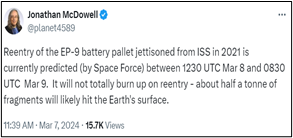
@plantet4589 on X
Reasonable agencies and persons in the space community disagreed with NASA’s conclusions. We argued that NASA made certain assumptions as to the terminal velocity of surviving particles that proved to be wrong, and the miscalculation was negligent.
Per NASA’s own policy on debris reentry, it knew that the uncontrolled reentry of EP9 could not be guaranteed to avoid inhabited landmasses.78Debris Mitigation, supra note 68.
Thus, we also contended that other options which were available to dispose of EP9 were not adequately considered, including potentially smaller uncontrolled reentry payloads or the much more-costly single purpose mission of retrieval of EP9.
Additionally, the European Space Agency (“ESA”) provided real time data and warnings to its citizens as EP9 approached reentry.79Reentry of International Space Station (ISS) batteries into Earth’s atmosphere, supra note 77.
NASA did not provide similar public information or warnings as the space debris reentered Earth’s atmosphere and was projected to reenter near the Gulf of Mexico and Florida. The ESA seemed to acknowledge that parts of EP9 “may reach the ground,” and it put public information out as a warning, although it also noted that the likelihood of a person being hit was “very low.”80Id.
To prove entitlement to damages, we considered which experts would be able to show that NASA made miscalculations. However, following with discussions with Mr. McDowell, we understood that the challenge of determining the exact reentry of a space object is not necessarily possible due to various factors including space weather, other space debris objects, and the general principle of reentry uncertainty.
NASA also indicated that as a matter of course it would revaluate its models based on this incident—and others that occurred in the months following the Oteros’ incident—but any such subsequent remedial measures would not be expected to be admissible in court.
Ultimately, we argued that the court would find that NASA was negligent and that such negligence proximately caused the damages in this case. But for the decision to jettison EP9 in an uncontrolled reentry to Earth, the incident and resulting damages would not have occurred. The only remaining question would be the amount of the damages owed.
C. Damages Limited by State Law
Under the FTCA, liability and damages are usually determined by reference to the state law where the suit was filed, Florida in this case. We argued the Oteros’ damages should not be limited by state law due to the Space Liability Convention, which does not provide such limitation. We argued that Daniel was entitled to $31,200.00; Alejandro to $37,680.83; Cindy to $15,600.00; and the homeowners’ insurance carrier to the value of repairs under its separate claim.
1. Property Damages
Property damages were straight-forward. The Oteros’ insurance carrier paid for repairs to the house in the amount of $14,151.22, but the property owners incurred $2,500 of out-of-pocket expenses for the deductible.
2. Property/Business Interruption Damages
Because Alejandro and Cindy both had to take time away from work to deal with the incident, another category of property loss included business interruption. The Oteros had to spend roughly 53 hours in total, and their business interruption damages were valued at $11,289.00.
Alejandro’s insurance carrier did not assist in the coordination of repairs, so, he and Cindy had to coordinate repairs. Alejandro selected the contractors, obtained estimates for the insurance carrier, and determined the required scope of work. Alejandro had to find someone to temporarily cover the roof before the repairs could start. During this period, Alejandro could not work at all and he had to direct and supervise the contractors. When roofing work is done, the repairs are loud and disruptive, and they prevented Alejandro, who worked remotely, from being able to make calls.
For painting and drywall repairs, Alejandro had to arrange and help find the right interior paint, source it and investigate what kind it was, call the paint store, follow up, and direct the painter to where to find it to make sure it was a match (to avoid having to paint more than was necessary).
For flooring repairs, Alejandro had to investigate who previously installed it, if the same material was still available, and then find a contractor to resell it to them. Unfortunately, their flooring was a discontinued product, so Alejandro had to make several calls and online research to find a suitable match. Then Alejandro had to deal with the flooring company, arrange payment and document it for insurance payment. Finally, the contractor installed the flooring, but while fixing the floor, it was noisy, and he again could not take phone calls. Similarly, with the air conditioning repair technician, Alejandro had to find the right contractor and get him to cut the flooring to size, and to repair the duct.
In addition to the property repairs, Alejandro and his family spent significant time trying to contact the right persons with NASA to discuss the issues and the claim. The Otero family contacted the sheriff’s department and fire department to investigate, researched space debris, governmental agencies, legislation, and communicated with experts in the space community to find the right NASA contacts. He made several attempts to contact NASA, leaving messages and emails, but there was no central location to receive such claims. NASA did not initially respond. Finally, Alejandro went to the local media, which reached out to NASA. Only then did NASA reach out to Alejandro requesting to analyze the material. All of the time required to deal with the space debris incident took time away from the Otero family’s work and income. Accordingly, we contended the Oteros’ business interruption damages were reasonable in light of the impacts the incident had on their lives. These damages were not covered by insurance.
3. Emotional distress/ mental anguish damages
We also contended that Oteros experienced significant emotional distress and mental anguish that as a result of the space debris incident. Daniel was present at the time and suffered mental anguish due to the shock of the event and the unknown nature of the space debris. The family had serious concerns about whether the space debris was hazardous until NASA provided reasonable assurance that it was not.
The Oteros were understandably fearful—at least for the period of uncertainty between when the incident occurred, March 8, 2024, through the first communications with NASA on March 22, 2024, when the Otero family felt more assured that the item was more likely than not space debris and unlikely to be hazardous to their health. The Oteros could have claimed a longer period of time, but the Otero family remained in good spirits and have not had the need to seek medical treatment.
For the thirteen days of living in uncertainty, we assigned a value of just $2,400/day for Daniel; and a similar amount for his mother and father during the time they were also filled with anxiety being away from their son when the incident occurred and seeking answers to this unknown event. Consequently, the Oteros demanded for $31,200 for Daniel and another $31,200 for Alejandro and Cindy to fairly compensate the family for the emotional distress and anxiety they experienced.
Under Florida law, there are restrictions on mental anguish or emotional damages which require physical injury lacking in the Oteros’ case. Additionally, there is case law that a “reasonable value” cannot be speculative but must be rooted in some rational basis for the claimed damages. We readily understood that these damages, without physical injury, would have been difficult to recover. However, the Space Liability Convention does not limit mental anguish to physical injury and has a much broader concept of damages. In other FTCA claims, parties have demanded the U.S. Government be required to “fully and fairly” compensate plaintiffs for property damage, loss of use, loss of revenue, post-crash expenses, and “all other just and proper relief.”81Blue Hills Helicopters v. United States, No. 1:13-cv-11888, (D.Mass. August 8, 2013).
4. Costs for assistance from third parties
Given the unique issues in this case, it was reasonable to consider reimbursement of the costs of the experts who assisted the Oteros as well as their legal fees. For legal fees, the firm agreed to a nominal value ($2,500.00). For expert fees, ESi was paid $5,791.83 total for its services. These costs were assigned to Alejandro’s claim.
D. Defenses to the FTCA claims
Several defenses were available to NASA in this action, and NASA could have simply denied the Oteros’ claim. Their potential defenses would have included the discretionary function exception as well as ordinary tort defenses. However, NASA wanted to make clear that it took the Oteros’ claims seriously. Ultimately, after evaluating the risks and costs of litigation and without admission of any fault or liability, NASA agreed to resolve the case to the Oteros’ satisfaction.
1. Discretionary function exception
NASA could have argued the Oteros’ claim was barred because NASA exercised a discretionary function that led to the discharge of EP9. Under the discretionary function exception (“DFE”), claims “based upon the exercise or performance or the failure to exercise or perform a discretionary function or duty on the part of a federal agency or an employee of the Government” may not be brought against the United States, even if the exercise of discretion in question was abused.82See 28 U.S.C. 2680(a).
The courts have established a two-part test for determining whether the DFE applies. First, courts must determine whether the government conduct is the subject of any mandatory federal statute, regulation, or policy prescribing a specific course of action, such that the government employee has no rightful option but to adhere to it.83Baum v. United States, 986 F.2d 716, 720 (4th Cir. 1993).
If the government employee has no rightful option but to adhere to the statute, regulation, or policy, he is not performing a discretionary function. On the other hand, if there is “an element of judgment or choice,” the function performed is discretionary.84Id.
The second step in determining whether the DFE applies is to determine whether the conduct in question involved discretion “based on considerations of public policy.”85Berkovitz v. United States, 486 U.S. 531, 536-537 (1988).
In determining whether a decision is based on considerations of public policy, courts presume that the actions of a government agent are grounded in policy when he is exercising discretion pursuant to statutes or regulations which set forth that governmental policy.86United States v. Gaubert, 499 U.S. 315, 324-325 (1991).
In Dreessens v. United States, the DFE was used to bar a claim against the United States where the plaintiffs alleged the government failed to maintain a road where a car accident occurred.87See Dreessens v. United States, Nos. 1:03CV0360 and 1:03CV0361 (M.D. N.C. Aug. 31, 2004) (unpublished).
One of the drivers involved accidentally drove off the paved road located near a military base onto the dirt shoulder in an area where the drop-off was approximately three inches. When the driver attempted to steer her vehicle back onto the paved road, she lost control of the vehicle and crossed the centerline hitting another vehicle head-on, causing three fatalities. The plaintiffs sued the government, alleging that the government failed to properly maintain the road where the accident occurred. The government moved to dismiss the action, alleging the court lacked jurisdiction because the claims were barred by the DFE.
The court granted the government’s motion to dismiss, rejecting the plaintiffs’ argument that Army Regulation 420-7288Army Regulation 420-72 “prescribed administrative policies, procedures, and responsibilities necessary . . . to plan, program, and perform maintenance, repair, minor construction, quality assurance, and control” of various surfaced areas. The Regulation further provided that “shoulders will be maintained to design template,” and that “shoulders may be paved when necessary.” Plank Road’s design template permitted a drop-off of up to two inches at the time of the accident.
and Army Technical Manual 5-624 § 6-389Army Technical Manual 5-624 § 6-3 provided that “shoulders will be maintained such that they are flush with or slightly below the edge of pavement.” The Manual further instructed that “priority in making repairs depends on operational requirements, traffic intensity, and consideration of the hazards that would result from complete failure.” Id. at § 1-4(b)(2). The introductory section of the Manual explained that the Manual was designed to provide guidance to those involved in maintenance decisions across several military branches.
did not allow government employees any discretion in the details of repairing and prioritizing repairs of the road. The court noted that a military spokesman had interpreted the Regulation as leaving room for discretion, and that an agency’s interpretation of its own regulations control unless the interpretation is “plainly erroneous or inconsistent with the regulation.” It further noted that various portions of the Manual actually appeared to create, rather than exclude, discretion on the part of military personnel.
In the Oteros’ case, there was no statute, regulation, or law that required NASA to handle the discarding of EP9 in any way. Instead, disposal appeared to be up to NASA’s discretion. With regard to the second step of the DFE analysis, the court in Dreessens held that “the decisions of how to allocate limited financial resources within a military budget and how to prioritize needed repairs on military property are inextricably tied to numerous public policy considerations.” Accordingly, the court held that the DFE applied and the suit against the government was barred.
While the Oteros’ case did not involve the design, repair, maintenance, or construction of a road, which have been found discretionary, the facts seemed to indicate that there was some discretion taken on the part of NASA in determining the manner in which to maintain the ISS and discard the depleted batteries on EP9. NASA presumably analyzed the decision to discharge EP9 in light of its various policy obligations, such as its Orbital Debris policies. It was also likely constrained by limited funding resources for a separate mission to retrieve EP9 and exercised some discretion in allowing the uncontrolled reentry of EP9 to Earth.
2. Tort defenses
NASA also would have had the same defenses to the negligence claim as any other tortfeasor.9028 U.S.C. § 2674.
We anticipated NASA’s first defense to be simply that there was “no breach of a standard of care” because NASA argued it adhered to all policies and procedures required. The claimants would have to show “breach” of the standard of care. In space operations, what is the standard? Although there are some general industry practices, there is no consensus on the standard of care for a government to exercise in international space operations. Arguably, NASA is the standard.
It would have been extremely challenging to engage experts in the field to argue that NASA was negligent in its orbital debris modeling and decision-making in the Oteros’ case. Some astro-physicists questioned NASA’s determination that EP9 would totally burn up in the atmosphere due to the size and type of material the pallet contained, but those concerns appeared to have been raised after reentry.
NASA could also have argued “act of god,” and other defenses that seek to prove that there was no proximate cause between the alleged wrongdoing and the damages. Sometimes, even with all appropriate measures being taken, there are still accidents that are of no fault. Defense attorneys are well-familiar with the concept that not every injury or damage is the result of fault. The Oteros would have had to prove that there was some reasonably predictable way to determine that parts of EP9 would have broken off, at which points, and where they would have landed –if NASA’s orbital debris modeling did not predict a reasonable expectation of landfall, what would have? We would have had to rely on experts to challenge the modeling NASA used.
While we also made arguments of the lack of proper warning in comparison to some of the public warnings the ESA made to its citizens, a warning would not have been very effective. One could not seek shelter or avoid the area where there was no reasonably predictable way to determine where parts of EP9 could have broken off and made landfall. Arguably, if there had been some public notice, amateur and professional astronomers may have been able to visually identify and track with some reasonable accuracy where pieces might make it to the surface of the Earth, but this argument may have proven to be too speculative to prove in a court.
NASA might also have argued there was a lack of indispensable parties in the action, as the ISS program is not a U.S. owned and operated mission. Rather, the ISS is a collaborative international mission with joint decision-making authority from various countries and agencies. The ISS Intergovernmental Agreement (IGA) is an agreement that primarily outlines how the “Partners” should act in maintaining the ISS all in the name of international peace. If a claim arises, the Partners “shall consult promptly on any potential liability, on any apportionment of such liability, and on the defense of such claim.” As a whole, this treaty is primarily focused with the Partners and their commitments, duties, and obligations regarding the ISS, but we argued that if NASA made full payment of liability that it would have had the ability to seek apportionment of such liability from the other Partners in the ISS IGA.
At the end of the solar day, though, the court of public opinion was the most persuasive to NASA to maintain its reputation of handling space operations in a safe and sustainable manner. If the public felt NASA required a different and more difficult standard to seek compensation compared with foreign nationals, and if NASA did not step up to take responsibility for the damages in the Oteros’ case, it would have faced more negative publicity and harm to its reputation in the space community regardless of its viable defenses to assert in court.
V. Settlement
In researching whether any such other claim was analogous to the Oteros’ claim, we noted that NASA had dealt with astronaut wrongful death claims and damages involving space operations in the past. However, there was no other case where people or bystanders unrelated with space operations were injured or damaged by a space object that was already in outer space in orbit and had returned to Earth. This was the first space debris claim.
The Oteros and the homeowners’ carrier agreed to settle their claims for the following non-confidential amounts:
- Cindy- $7,500
- Alejandro- $10,000
- Daniel- $12,500
- Homeowner’s carrier- recovery of the property repair damages $14,151.22
This result was reasonable in light of the complexity of the legal issues involved, the factual issues and causation questions, and the challenges the Oteros and the carrier would have faced in prosecuting the claims. While NASA would have been able to defend against claims in court, it chose to resolve the claims to the Oteros and their carrier’s satisfaction.
After the Oteros signed the releases, it took quite some time for NASA to countersign, in part because there were changes in the agency administration during that time. After the releases were fully executed, NASA submitted the claim to the Judgment Fund, but no payments were issued for months. Ultimately, we had to involve NASA’s OIG to investigate the delay in payment, and NASA contacted the Judgment Fund and secured the issuance of payments.
It has truly been a journey through the galaxy. The claims process makes clear that there is room for improvement and creativity in how the U.S. might handle space liability claims in the future. This incident is an opportunity to engage in discussions of how to report, vet, and manage resolution of space operation related claims.
A final question remains: What happens to space debris in NASA’s custody? (Hint: NASA has denied the Oteros’ request to return the “abandoned property” to them.)
View Article
Back